A Line, a Shape, a Sequence: Three Ways to Vary One Idea
Vary one creative idea through line, shape, and sequence to see which formal change opens new possibilities without losing the subject that started it.
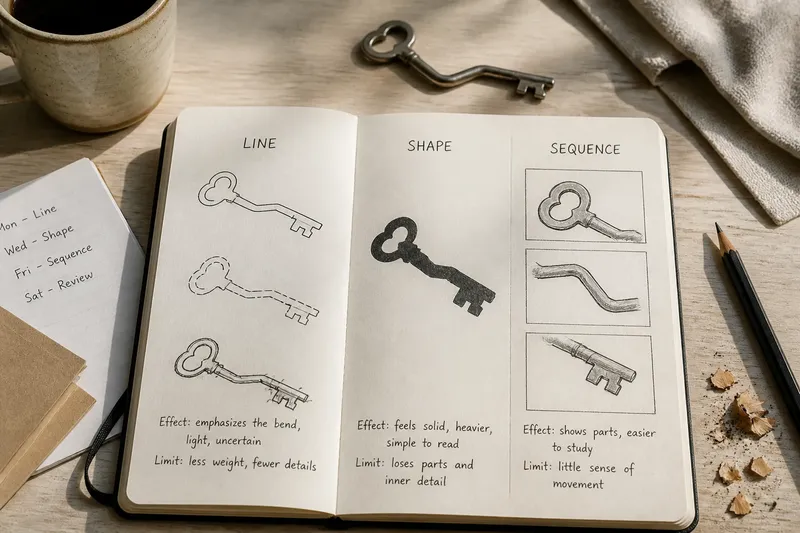
A sketch of a bent key can become a long, continuous line, a blocky silhouette, or a small sequence of turns. Varying one creative idea this way keeps the starting subject in view while changing how it appears. The useful distinction is between changing the form and changing the subject: alter one at a time, and you can tell which kind of change is doing the work.
Artists, writers, and designers have used variation as a working method because an idea need not be exhausted by its first version. The practice does not require a grand theme or a polished result. It needs a source you can return to and a simple record of what you changed. Over a week, three short sessions can reveal more than an afternoon spent asking the original idea to become impressive.
Keep the subject steady while changing its form
Choose a subject that can survive several treatments: a key, a folded receipt, a doorway, a kettle, or a phrase such as “the train is late.” Write it at the top of a page or place the object beside your work. This is the anchor. During the first pass, do not add a new subject, setting, character, or argument.
Form is the arrangement or presentation of material. In a drawing, it might mean contour, silhouette, or a sequence of panels. In prose, it might mean a single sentence, a list, or a short scene made of fragments. In sound, it might mean a sustained note, a repeated motif, or a phrase broken into parts. The medium changes the available choices, but the question stays plain: what happens when the same subject is organized differently?
Say you begin with a bent key. You draw it as one uninterrupted line, then as a solid silhouette, then as three frames showing its bow, shaft, and teeth. The subject remains the key; line, shape, and sequence are the variables. You might notice that the line emphasizes its bend, the silhouette makes it feel heavy, and the frames invite you to read it as an object with parts. Those are observations, not verdicts about which version is best.
Use the week to make three distinct passes
Set aside three sessions on separate days, with a little room between them. Keep each session short enough that you can finish a pass before the urge to decorate it takes over. A notebook, index cards, a pencil, and a phone timer are enough; the timer is there to mark an ending, not to turn the exercise into a contest.
- Monday: the line. Make several versions using continuous, broken, heavy, or hesitant lines. In writing, try a flowing sentence, a sequence of clipped clauses, or a line break that changes the pace. Keep the subject fixed and note what the line makes easier to notice.
- Wednesday: the shape. Reduce the same subject to a silhouette, a block of text, a repeated arrangement, or a compact visual mass. Remove interior detail where the medium allows it. Notice what survives when texture and explanation fall away.
- Friday: the sequence. Divide the subject into a few moments, views, or stages. A drawing can become panels; a paragraph can become ordered fragments; a sound can be arranged as an opening, return, and interruption. Keep the sequence tied to the original subject rather than adding a new plot for convenience.
At the end of each pass, write one sentence about the effect and one about the limit. “The broken line makes the key look uncertain” is more useful than “I like this.” “The panels make its parts clear, but suggest no movement” gives the next session something specific to test.
Change the subject only after the formal pass
Once the three versions exist, make a second round in which the form stays put and the subject changes. Keep the continuous-line treatment, for example, but replace the key with a spoon, a doorway, or a bent paper clip. In prose, retain the clipped-sentence structure and change the scene or object. Now you are testing what the form does across subjects, rather than what one subject can do in different forms.
This distinction matters because the two kinds of variation answer different questions. Changing form asks, “What can this material become?” Changing subject asks, “What does this treatment bring out in different material?” If both shift at once, the result may still be interesting, but it becomes harder to trace why. A useful experiment is not required to isolate every influence; it only needs to make its main change legible.
What is not worth the effort is making a large collection of near-identical versions. A page of tiny adjustments to line weight may help if line weight is the question, but it will not tell you much about sequence. Stop when the versions begin repeating the same answer. More pages can be a respectable way to avoid choosing what to look at.
Decide what to carry forward
On Saturday, place the versions side by side or read them in a row. Do not rank them as finished products. Instead, mark the one that exposes a feature you had not noticed, the one whose constraints produced a useful surprise, and the one that feels too dependent on explanation. A small mark in the margin is enough.
Then choose one element to carry into a fresh piece: perhaps the silhouette’s compactness, the sequence’s changing viewpoint, or the line’s sense of hesitation. You are not obliged to use the whole version. Variation is useful partly because it separates a working feature from the arrangement that first contained it.
If none of the passes opens a direction, record that too. The subject may be too familiar, too broad, or simply not suited to the forms you chose. Put it aside without turning the result into a judgment about your ability. A different anchor or a different set of formal options may be more revealing.
Questions that clarify the experiment?
How many versions should I make?
Make enough to show a real difference in treatment, not enough to fill a page. A few distinct attempts per pass will usually make the contrast easier to read than a long run of tiny adjustments.
Can I use this method for writing?
Yes. Hold a subject or situation steady while changing sentence shape, paragraph arrangement, or order of events. Keep notes about the effect of each form so the exercise does not quietly turn into several unrelated drafts.
What if the subject changes while I work?
Write down the new subject on a separate line and finish the current pass if it still has value. Treat the new material as a later variation; that keeps an appealing detour from obscuring what the first experiment was asking.
When should I stop varying the idea?
Stop when the changes no longer reveal a different emphasis, rhythm, or reading. Carry forward the one feature that remains useful, or choose a fresh subject if the current one has stopped giving you meaningful distinctions.
Varying one creative idea through line, shape, and sequence is a modest way to make form visible: the same material can feel different without being replaced. Keep the versions, including the awkward ones, but label the change you made. Later, that small note can distinguish an accidental shift from a choice you may want to use again.