A Five-Minute Review for a Project You Have Set Aside
A five-minute review of a paused project helps you separate what still interests you from what no longer fits and choose one small next action.
The notebook is open beside a mug gone cold, and the project inside it has not moved since the page where you wrote “come back to this.” A five-minute review can help you decide what that project is now: something you want to continue, something that needs a different shape, or something you can leave alone without turning the decision into a referendum on your character.
What is a five-minute review for a paused project?
A five-minute review is a brief check-in with the project as it exists today, rather than a demand to resume it. The aim is to notice three things: what still draws your attention, what no longer fits, and one small action that would clarify your next choice.
That distinction matters. A project can remain interesting even if the original plan has become impractical. A sketchbook series may still appeal, while its intended format, audience, or schedule does not. Reviewing the parts separately keeps “I don’t want this version” from being mistaken for “I don’t want any of this.”
Five minutes is enough for a first pass because the task is not to solve the project. It is to make a decision that is proportionate to what you currently know. You can use a timer, but a phone alarm or a glance at the clock works just as well. The timer is a boundary, not a tiny project manager.
How do I start without pressuring myself to restart?
Begin with the most recent useful trace of the project: a file, notebook page, folder, draft, object, or message to yourself. Spend the first minute looking rather than fixing. Notice what is actually there, including unfinished pieces and practical constraints, without treating every loose end as an obligation.
Then write one plain sentence to describe the project in its current form. “A collection of short notes about neighborhood storefronts” is easier to assess than “the big creative project I should finish.” A concrete description gives you something to respond to; a verdict about your discipline does not.
For the next minute, ask what still interests you. Keep the answer specific. It might be the subject, a material, a question, a recurring image, or the pleasure of making a particular kind of thing. “I still like the idea” is a start, but “I still want to compare the hand-painted signs on my route” gives you a clearer signal.
Use the following minute to name what no longer fits. Be equally concrete: the intended audience, a deadline you no longer have, a format that feels cumbersome, or an assumption you no longer believe. These are observations, not charges against the earlier version of you who made the plan. Earlier versions of us are often busy and optimistic; they have not been consulted about the calendar.
In the fourth minute, choose a small next action that gives you information or makes a modest piece of progress. In the final minute, write down what you will do and what you will not do for now. The second part helps keep a limited next action from quietly expanding into a relaunch.
What should I ask myself during the review?
Use questions that separate interest from obligation and a useful next move from a whole new plan. Answer in fragments if that is faster; polished prose is not the assignment.
What part of this project still interests me?
Name the element you would choose to keep if you were not required to preserve the original plan. It may be a topic, image, material, or problem, and it can be smaller than the project’s original premise.
What no longer fits the project I want now?
Identify a specific assumption, format, audience, or commitment that feels out of date. You do not have to replace it immediately; noticing the mismatch is already useful information.
Am I avoiding the work, or has the reason to do it changed?
Look for the difference between a task that still matters but feels uncomfortable and a goal you no longer endorse. If you cannot tell, record the uncertainty rather than forcing a confident answer.
What is one small action that would help me decide?
Choose something narrow enough to do without rebuilding the entire project, such as rereading one page or saving one reference image. A useful action should make the next decision clearer, even if it does not produce a finished piece.
How do I choose a next action that stays small?
A small next action has a clear edge. “Work on the project” has none; it could mean opening a file, revising the premise, buying supplies, or spending the afternoon reorganizing a folder so the actual work can remain safely elsewhere.
Try phrasing the action as a single observable move:
- Read one page of the draft and mark one sentence that still has energy.
- Look through a folder and save one reference image that remains relevant.
- Write a short note about the part of the idea you would keep.
- Move one outdated requirement into a “not for now” note.
- Make one rough sketch, sample, or outline fragment to see whether the subject still interests you.
These are options, not a menu you must complete. Choose the action that answers the most useful unresolved question. If you already know what you want to keep but not what form it should take, a rough sample may help. If you are unsure whether the premise still matters, rereading the original notes may be enough.
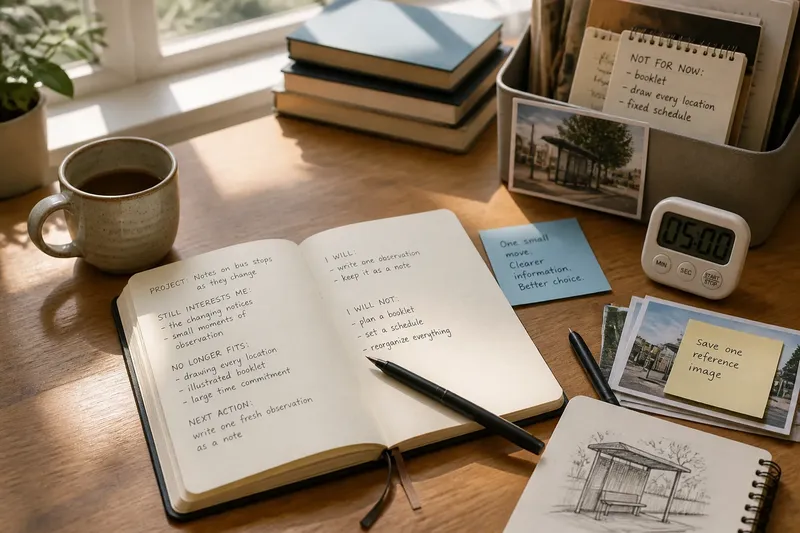
Say you set aside a small collection of observations about bus stops because the planned illustrated booklet became too ambitious. During the review, you notice that recording the changing notices still interests you, while drawing every location no longer fits. A suitable next action might be to write one fresh observation and leave it as a note, without deciding yet whether it belongs in a booklet, a list, or nothing at all.
The point is not to disguise a restart as a tiny task. If the action immediately requires a new schedule, a full inventory, and a decision about the finished product, it has probably grown beyond the review. Reduce it until it tests one question.
What if I feel nothing, or the project now feels wrong?
If nothing stands out, write that down plainly. No clear interest is information, though it may reflect fatigue, distance, or an unhelpful entry point rather than a final decision. You can leave the project paused and revisit it only if a new reason appears. A project does not need a dramatic ending to remain set aside.
If the project now feels wrong, separate the mismatch from the parts that may still be worth keeping. Perhaps the original topic has gone stale, but the method of collecting notes appeals. Perhaps the format creates more friction than the subject. You are allowed to keep a fragment and release the container it came in.
It is also reasonable to stop. Write a sentence explaining what you are choosing not to carry forward, then close the file or notebook. This is not the same as declaring the work a failure. It is a decision about where your attention belongs now, made with the information you have rather than a promise to feel differently later.
What is not worth the effort is reconstructing the project’s entire history before you can make a modest decision. You do not need to locate every reference, remember why each idea was added, or produce a persuasive case for keeping or abandoning the work. Start with what is available and let the review stay small.
Should I repeat the review, or leave the project alone?
Repeat the review when you have a new reason to reconsider the project: a change in available time, a useful connection, renewed curiosity, or a clearer sense of what you want from it. Repeating the same review just to force enthusiasm is unlikely to make the answer more honest.
If you choose an action, do only that action before deciding whether the project deserves further attention. Afterward, notice what happened: did the work draw you in, reveal a problem, or simply confirm that you are not interested now? The observation does not need to be dramatic. A quiet “that was enough for today” is still an answer.
If you leave the project paused, make the status easy to recognize. A note on the folder or the first page can say what still interests you, what no longer fits, and what would prompt another look. Keep it brief enough that returning does not require reading a private archive. The five-minute review is useful because it gives the project a truthful next state, including the possibility of no next action.